
The launch of Jev brought a familiar pair of psychology terms into the AI conversation. TypeSafe calls Jev a System One model. But the more interesting story is the idea behind the name: human thought does not always arrive in the same way.
Psychologist Daniel Kahneman made System 1 and System 2 widely known through his 2011 book Thinking, Fast and Slow. The labels were already in psychology. In his Nobel lecture, Kahneman credited researchers Keith Stanovich and Richard West with naming two broad modes of cognitive processing.
Two modes, not two machines
System 1 and System 2 are not separate organs or two little decision-makers inside the head. They are shorthand for patterns of mental activity. Reviews of dual-process research find a useful broad contrast, but also many different processes that do not fit neatly into two boxes.
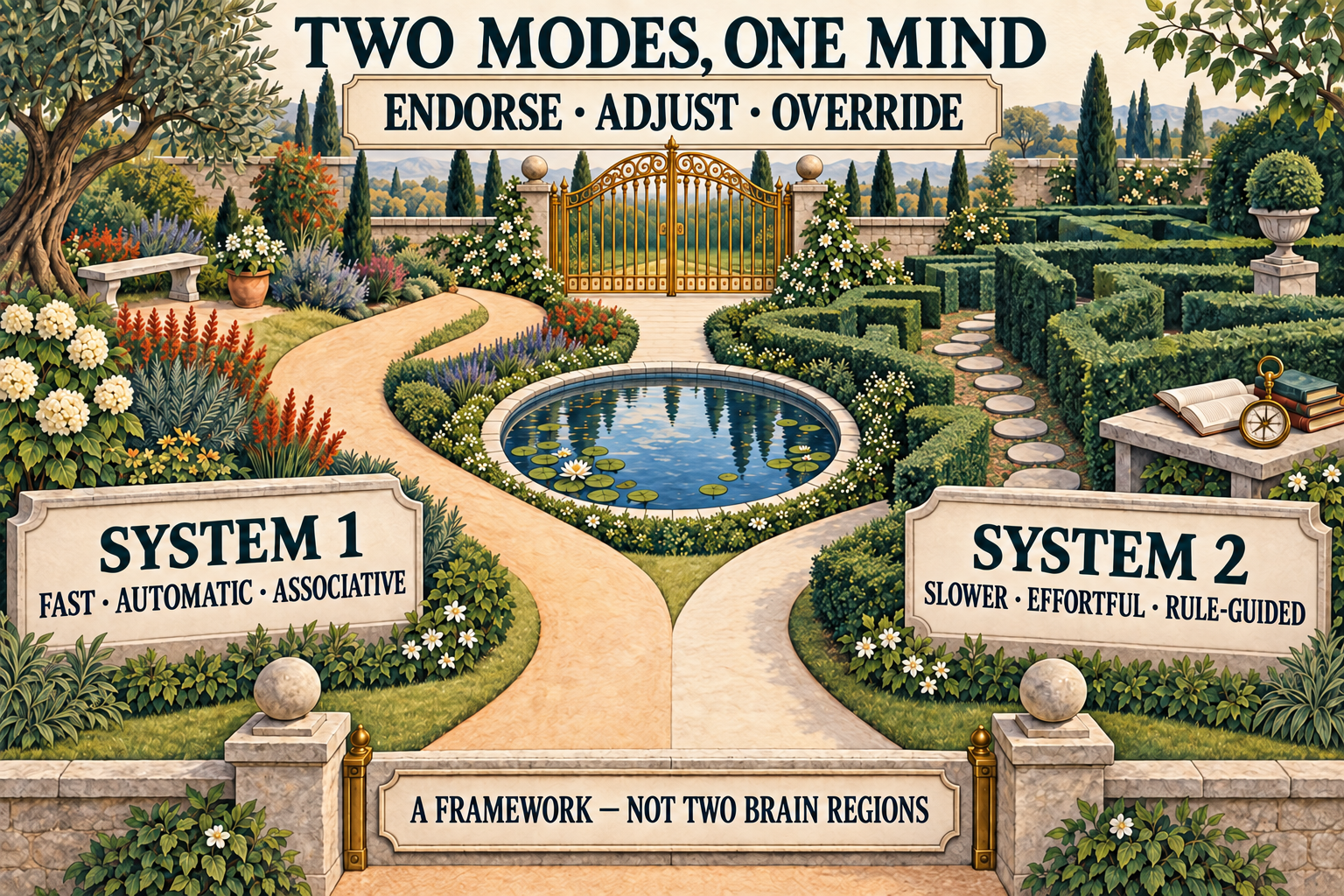
System 1 is fast, automatic and associative. It produces the impressions that seem to arrive by themselves: recognising a familiar face, noticing a sudden movement, reading a common phrase or steering along a well-known route. It includes learned skills as well as basic reactions.
System 2 is slower, effortful and deliberately controlled. It becomes important when you hold several facts in mind, follow an unfamiliar rule, compare competing explanations or check a calculation. A later account by Jonathan Evans and Keith Stanovich defines this mode partly by its reliance on working memory and its ability to consider hypothetical possibilities.
The first answer is not always the final one
A famous example asks about a bat and a ball that cost $1.10 together. The bat costs $1 more than the ball. Ten cents comes to mind quickly, but a check shows that the ball must cost five cents and the bat $1.05. The first answer feels right because the numbers separate so easily.
Shane Frederick used that problem in the Cognitive Reflection Test, designed to measure the tendency to pause and resist an immediate response. The lesson is not that fast thinking is foolish. It is that a plausible answer can reach awareness before anyone has inspected it.
Fast thinking is often good thinking
System 1 is what lets daily life move. Kahneman noted that most behaviour is intuitive, skilled and successful. A fluent reader does not sound out every letter; an experienced driver does not calculate every small steering correction. Speed often reflects practice.
Problems appear when an easy impression stands in for a harder question. A vivid example may feel more common than it is. The wording of a choice may make one feature unusually prominent. System 1 supplies what is most accessible, even when the missing information matters more.
How the two modes work together
In Kahneman’s model, System 1 continually generates impressions and possible responses. System 2 can endorse them, adjust them or block them. Most of the time there is no dramatic handover: the quick impression is good enough, and deliberate thought simply accepts it.
System 2 is not an all-purpose truth machine. It has limited attention, depends heavily on working memory and can apply a bad rule with great care. Time pressure and competing tasks make deliberate correction harder. Slow thinking creates an opportunity to check; it does not guarantee the right result.
What the metaphor means for AI
Jev does not recreate human System 1, and a language model is not a synthetic System 2. The names borrow a psychological contrast for an engineering purpose. Jev is designed to return bounded judgments, while generative models can produce open-ended language. That resemblance is useful, but it remains a metaphor.
The psychology leaves a practical habit: notice how an answer arrived. Was it immediate because the pattern was familiar? Does the decision carry enough risk to deserve a second look? System 1 gives us speed and fluency. System 2 gives us a chance to inspect, compare and revise.