
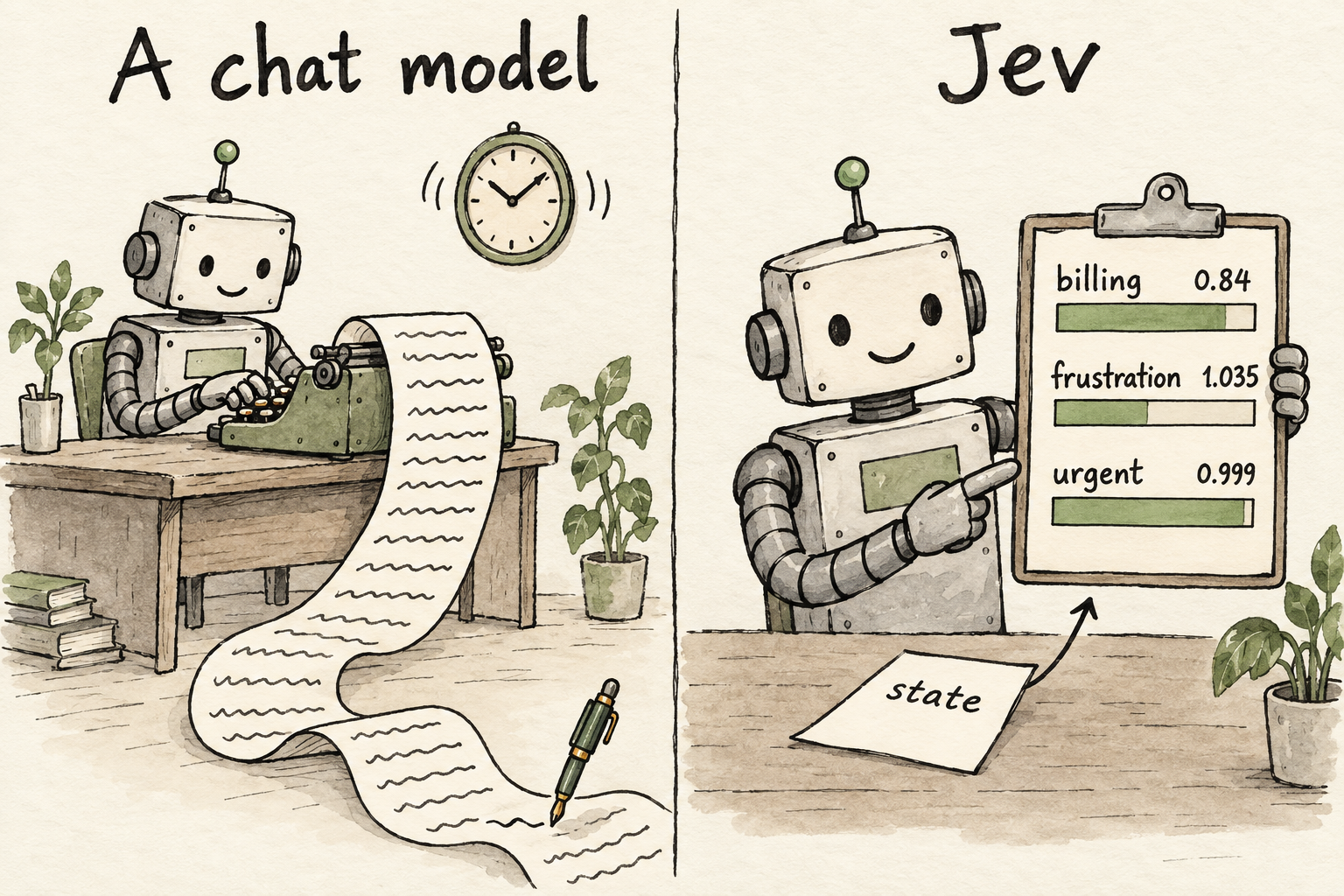
A chatbot writes. It types back a paragraph, one word-piece at a time, for a person to read. That is awkward when the reader is a program, which wants a decision, not prose. TypeSafe AI, a San Francisco start-up, calls this a mismatch.
On 15 September 2026 the company released Jev, its first model, in early access, the first of what it calls System One models. Jev never writes a word. You send it some text, which it calls the state, and questions with fixed possible answers; it sends back one answer per question with a probability attached. The founder’s description: “unstructured state in, typed probabilistic decisions out.”
Three kinds of question
The questions come in three kinds. A Choice picks one option from a list you give. A Score rates the text on a scale of levels you describe in words, and the answer can land between two levels. A Noul is a yes-or-no question, answered with a number from 0 to 1: the probability that the answer is yes. The docs’ quick-start example puts all three on one support message.
Jev picked billing, but gave technical a 16% chance, and its confidence in the pick was only 0.596. A chatbot’s one-word reply would have hidden that hesitation; a program can see it.
All the questions in a request are answered at once, each on its own, so adding more barely changes the response time. TypeSafe’s advice is to ask small “gut-check” questions and combine them in code: instead of “rate this startup pitch”, ask about market size, technical feasibility and differentiation separately, then weight them yourself.
Confidence: the model saying “I’m not sure”
Every Choice and Score answer also carries a confidence number from 0 to 1, a summary of how piled-up its probabilities are. It is the model’s way of saying “I’m not sure”, and TypeSafe argues that a system which cannot say that cannot be trusted.
The docs suggest three bands: act automatically, proceed with caution, or hand it to a person. In the docs’ banking example, showing a balance is low-risk, but approving a transfer needs more than 0.9 confidence, and anything under 0.5 goes to a human.
Fast and cheap
Jev is trained with a method TypeSafe calls reinforcement learning for calibrated decisions. Calibrated means that, across many answers, the things Jev rates 0.8 should happen about 80% of the time. It also answers differently from a chatbot: every answer is filled in at once instead of word after word, which is where the speed comes from. The company says most queries take about 100 milliseconds, and it charges $0.042 per million input tokens, with output tokens free.
One company example is search. For 40 legal questions over 3,565 passages, a keyword search put the right passage first 5% of the time. Re-ordering the top 30 with one Jev question per candidate raised that to 18%, and put the right passage in the top ten 62% of the time instead of 38%.
What it is bad at
TypeSafe keeps a public page of Jev’s rough edges, last reviewed on 17 September 2026. Its first line is “Jev isn’t perfect.” Jev reads a question literally, “the question you wrote, not the one you meant.” It “is not a calculator”: it cannot count reliably, and it reads dates as text. Text written to steer it “can move the answer”.
On a ticket about a double charge, “Is the customer asking for a refund?” scored 0.72 and “Is the customer asking for something other than a refund?” scored 0.47. That adds up to 1.19, not 1, so the page says not to expect arithmetic between separate questions. And Jev cannot write: “there are other models for that.”
Read the claims twice
The launch post says Jev “can’t hallucinate”. Two independent write-ups point out what that means: it cannot answer outside the options you gave it, but it can still pick the wrong one, confidently. As TrueFoundry, a software company, put it: “what’s been eliminated is the malformed answer, not the mistaken judgment.”
Its home page claims 193.6 times faster and 444.6 times cheaper than large language models. Those multiples come from a test the company invented, scored against two rival models’ answers rather than human-checked truth; the launch post says they sit “on the higher end of real world gains”, and TypeSafe publishes no results on public benchmarks. It has $40 million in seed funding; its founder, Diogo Almeida, co-wrote the 2022 InstructGPT paper at OpenAI.
Why “Jev”
“System One” comes from Daniel Kahneman’s Thinking, Fast and Slow: System 1 is fast, intuitive thinking, System 2 slow and deliberate. “Jev” is named after William Stanley Jevons, the economist who noticed in 1865 that more efficient coal use led to more coal being burned, not less. TypeSafe expects intelligence to go the same way: “Every order of magnitude drop in the cost of intelligence unlocks orders of magnitude more use cases.”