

If you build an AI model today and you want other people to use it, you put it on Hugging Face. It is a website where people leave the models they have built for other people to download. Nvidia, which agreed to buy the company in September 2026, said in its announcement that more than 18 million developers, researchers and creators use it, and that they have put more than three million models on it.
It started as a chat app for bored teenagers.
The app that wanted to be your friend
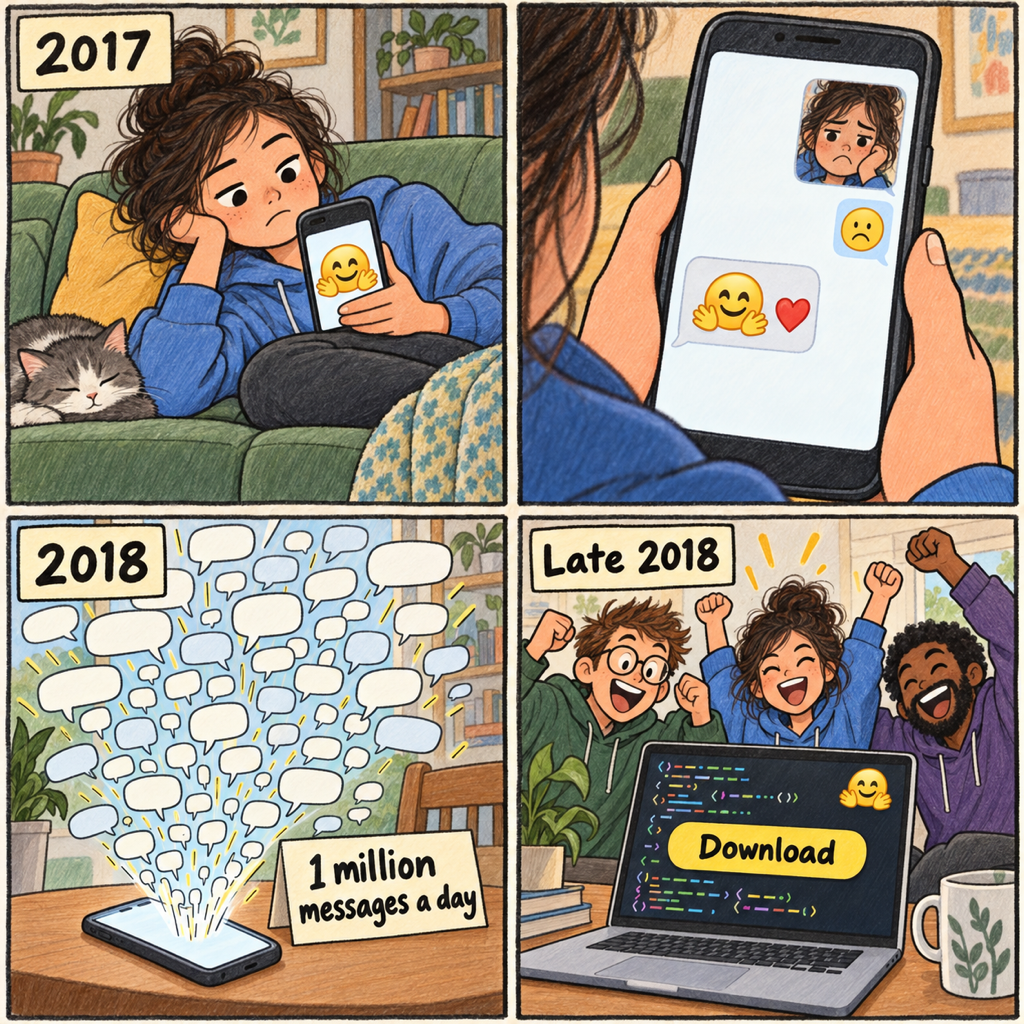
“Meet Hugging Face, a new chatbot app for bored teenagers.” That is how TechCrunch opened its review in March 2017. Three friends from France had started the company in New York in 2016, and they had put an app on the iPhone that made you a digital friend. You named it, picked its picture and texted it. You could send it selfies, too: a photo of your face and a sad emoji, and the bot would have a go at working out how you felt.
“There are many people working on artificial intelligence for productivity or utility applications,” one of its founders, Clément Delangue, told the site. “We’re building an AI so that you’re having fun talking with it. When you’re chatting with it, you’re going to laugh and smile — it’s going to be entertaining.”
The name came from the 🤗 emoji, the yellow face holding up two hands to give you a hug.
Teenagers turned up. By May 2018 the bot was taking a million messages a day and had handled more than 100 million in all, and the company raised $4 million from investors who included the basketball star Kevin Durant.
The week of work they gave away
To build a bot that could hold a conversation, the team had to follow the research closely. In October 2018 Google released a new language model called BERT. It came as code for Google’s own set of programming tools, and plenty of researchers used a different set. So Hugging Face rebuilt BERT, piece for piece, for the other toolkit, and then put the result on the internet free for anyone to use or change. Their first release went out on 17 November 2018.
Why hand over a week of work for nothing? Delangue’s answer, quoted by Sequoia Capital, one of the company’s investors: “It just seemed to be something a lot of people would like to use”.
Researchers took it up. What they had given away was a library: a pack of ready-made code other people can build into their own programs. By December 2019 that library, by then called Transformers, had been downloaded more than a million times, and people at Google, Microsoft and Facebook were playing with it. That December, TechCrunch’s headline was not about the chat app at all. It called Hugging Face a company building “the definitive natural language processing library” — code for working with human language.
The company changed course. The chat app was no longer the point. What Hugging Face had worked out while building it, and the code it had given away, turned into something bigger: the place where everyone else now keeps their models.
So what is it that people share?
A model sounds like a machine. It is really a pile of numbers. Training an AI means running through huge amounts of text or pictures and nudging millions of little settings until the thing works. Those settings are then saved as computer files. Put the files online and someone else can copy them and run the model on their own computer, with the right free software to read them.
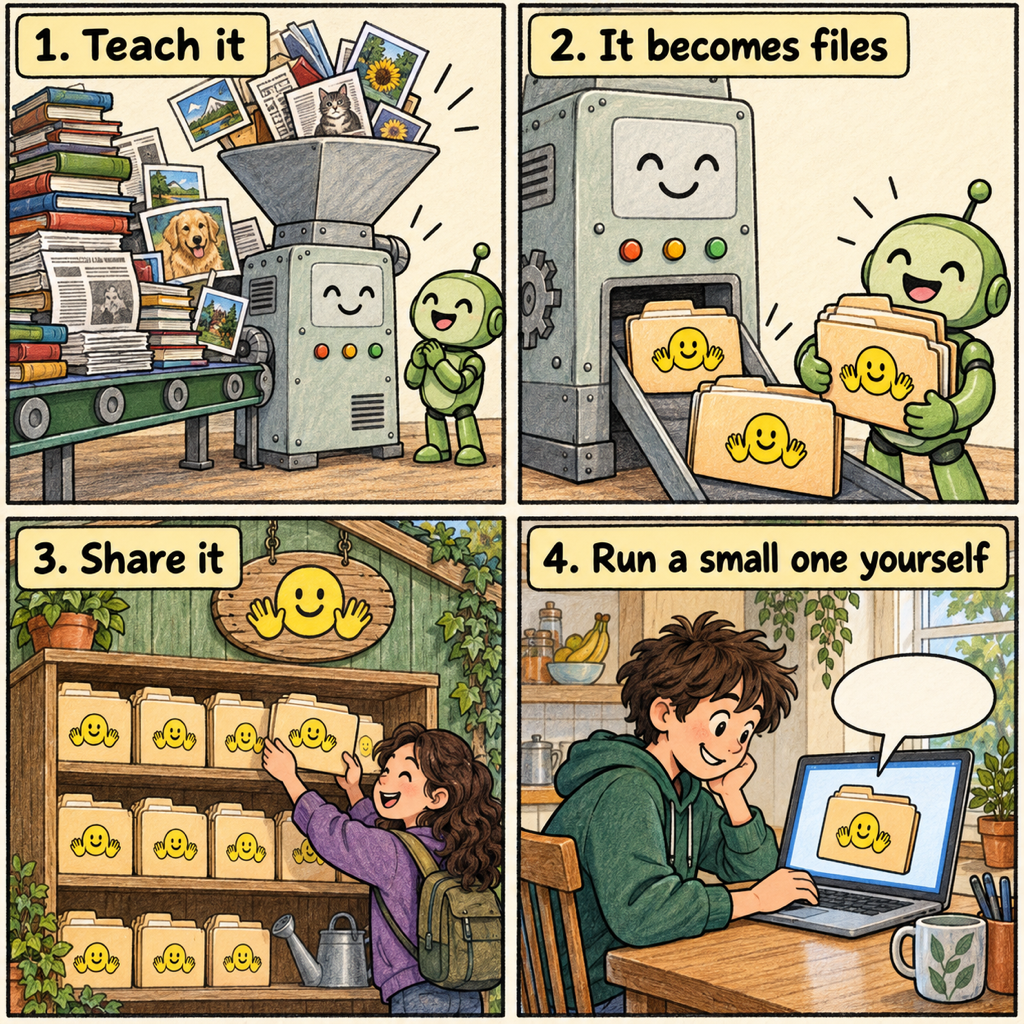
Hugging Face makes small models of its own. One family of them, SmolLM2, comes in three sizes, and the smallest, the one with 135 million settings, keeps those numbers in one file of 269 MB. The model’s page says these models are “lightweight enough to run on-device” — on a laptop or a phone, in other words. So we downloaded the version of it built to answer questions, along with the handful of small files that come with it and a free program to run them, and asked it what a hug is. It said a hug is “a warm and comforting physical gesture” that “can be used to comfort, comfort, and comfort someone”. Not brilliant. But nobody’s server answered that question. The laptop did.
That is what people mean by an open model: the numbers themselves are published, so you can run one yourself instead of sending every question to a company’s computers. It is not a free-for-all. Every model on the site can carry a licence saying what you may do with it, and some are gated, which means asking the people who made them for access first. But once the files are on your own machine, you can use them without the internet.
Ten years later
On 3 September 2026, Nvidia agreed to buy Hugging Face for $12,930,300,000. Announcing it, Nvidia’s chief executive, Jensen Huang, wrote that “Hugging Face will remain an open platform for the entire AI ecosystem”, keeping “their same iconic 🤗 brand”. In a post on X, reported by TechCrunch, Delangue thanked the community for showing that the company could be an alternative to closed AI services, and said that doing it on a bigger scale would take more computing power and more help: “it needs more compute, more support, more collaboration, and more visibility. That’s why we went to talk to Jensen”.
One last thing about that emoji. Unicode, the group that gives every letter, symbol and emoji an official name, still calls it, in its list of characters, HUGGING FACE. On Unicode’s emoji list it has since picked up a newer name: “smiling face with open hands”. The company kept the old one.